New Fiction
 Exit Party by Emily St. John Mandel
At a party in Los Angeles in 2031, some guests disappear while others seem to double. The party in question—thrown by a man named Kareem after curfew is lifted in the Republic of California—will be revisited many times over the course of Mandel’s glittering puzzle box of a novel. We first experience it through the eyes of Ari Waker, a woman who’s just spent 18 years in prison for hiring someone to kill her cousin. Midway through the party, the host disappears. At the same time, one of the guests seems to be in two places at once, wearing two different outfits; another guest takes a painting off the wall and leaves. Eventually it will all make sense, and doubly so to longtime devotees of this ingenious author: The painting, “Swan Dive,” first appeared in The Glass Hotel (2019), and is central to the plot here; there are also connections to The Singer’s Gun (2010) and Sea of Tranquility (2022). The current novel brilliantly ties the notion of parallel timelines to a political theme, positing a dark twinship between chaos and totalitarianism. As Ari’s own double eventually understands, “Strange to think there weren’t just two versions of me, and two versions of Kareem and Nico and possibly everyone else, but two versions of our country. There was a world where my homeland had fractured into disarray, and another where my homeland had closed like a fist.” Mandel’s elegant worldbuilding spans the course of a century, tracing events that occur in a domed Paris in the 2060s back to their roots in a New York apartment in the 1960s. This is her best novel since Station Eleven (2014), a cause for rejoicing among her fans and an inspiration for newbies to dive into the backlist.
 The Pirate Queen by Ariel Lawhon
Lawhon retrieves a legendary woman warrior from the mists of 16th-century Irish history. The extraordinary life of Grace O’Malley—Gráinne Ní Mháille, in Irish—overlapped closely with that of Queen Elizabeth I, and one of the high points of Lawhon’s latest historical novel depicts a meeting between the two, both rivals and allies, both sharply aware of their fraught positions as female rulers in a man’s world. Gráinne was the daughter of The O’Malley, chieftain of his clan, and distinguished herself at a young age by such unusual gifts and talents that she was taught the ways of the sea and assumed a constantly contested leadership over her father’s land and people after his death. Lawhon has never written a novel with a straightforward timeline, and her latest is no exception, interweaving episodes from three eras of Gráinne’s life—maiden, mother, and matriarch—so that a chapter where she is 56, for example, is followed by one where she is 8, and then one where she is 24. In her signature personable and informative author’s note, Lawhon suggests that one might reread this 400-plus page book a second time in chronological order and have a totally different experience. Some readers may wish that would have been the experience in the first place, as the braided approach seems to trade narrative momentum and clarity for [fill in the blank if you figure it out]. Confusing time management aside, it’s a thrilling story, and the fun that Lawhon clearly had with scenes of bloody mayhem, storms at sea, treacherous machinations, and low Gaelic dialect (“that fecking eejit,” “that cunting piece of shite,” and never just Galway, always “fecking Galway”) is contagious. Her pirate queen is brilliant, beautiful, and fearless; her loyal servants are adoring and capable; her male foes are sleazy scumbags and detestable boobs—all exactly as it should be.
 Mazywood by Tananarive Due
In the summer of 1926, a lonely little girl with monster talent and monster ambition submits a wish for her very own BFF and ends up with a…well, take a wild guess. The movies are literally in Hollywood screenwriter/producer Johnny Washington’s DNA as the grandson of Mazelle Washington, a legendary Black actress from the 1920s to the ’40s, who, as with such comparably gifted peers as Hattie McDaniel, was consigned to playing comedic servant roles during the studio system’s golden age, which coincided with the beginning of the steep, too-slow decline of racially segregated Jim Crow America. Johnny, who’s been fighting his own uphill battles with racially blinkered studio mavens in today’s presumably more enlightened era, has inherited the frayed but cozy remnants of Bear Creek Lodge, a ski resort near Northern California’s Mount Shasta, which Mazelle owned and operated as a 1950s getaway spot for Black celebrities like Lena Horne and Sammy Davis Jr., who, despite their star power, were shunned from similar establishments. Despite his fraught relationship with Mazy in her years of embittered semiretirement, Johnny appreciates being able to head to the mountains for rest and relaxation with his university professor wife, Tasha, and their teen daughters, Sharise and Imani. Both girls have, to varying degrees, inherited their grandmother’s energy and verve. Their mother, unbeknownst to them or their dad, is researching a book on Mazy’s tumultuous life. As they all settle in for what already seems a tense holiday amid the unrelenting Shasta snows, something big, strange, and scary lurks just beyond their immediate sight, leaving bizarre and alarmingly blood-soaked evidence of death and destruction. Through flashbacks masterfully woven throughout the novel by the redoubtable storyteller Due, this enthralling hybrid of showbiz history, supernatural mystery, and nail-biting adventure in the wild spins a chilling, enlightening, and ultimately heartrending saga of generational trauma, thwarted dreams, and familial devotion.
 Dead Beat by Leigh Bardugo
A dark fantasy set on the Yale campus ends with a bang. Galaxy “Alex” Stern of Lethe House, one of Yale’s storied secret societies, has been to hell and back. That was in Hell Bent (2023), the middle book in Bardugo’s Ninth House trilogy, where the secret societies wield not just temporal power but magic as well. Hell Bent ended with Alex and her friends rescuing her crush, mentor, and fellow Lethe officer, Daniel “Darlington” Arlington V, from eternal torment. One small wrinkle: The demon Golgarot used Alex’s blood to wedge a door open between Hell and New Haven, and his minions are slipping through. Also, one of the group has turned into a vampire, and Darlington is now half demon. “He’d given up some part of himself to preserve the rest of his human soul. He’d become both prisoner and warden.” As the final book opens, the exhausted crew are hunting yet another monster. They can’t keep this up forever; they will have to find a way to close the portal. Alex has the energetic, driven melancholy of the hard-boiled, dark fantasy heroine she is. She believes “magic is real, but safe is make-believe,” as her roommate puts it. An open hellmouth, a supportive scholar, a vampire whose story arcs precariously toward redemption, a gentleman fiend who gets literally horny when aroused, a California girl with rare supernatural powers who cracks wise as she fights fiends—the series has a lot in common with Buffy the Vampire Slayer and its spawn, but Bardugo’s way with words and her keen social observation keep the book from feeling derivative. A demon’s classic New England house is decorated with “ruthlessly inoffensive watercolor seascapes”; Lethe’s board president “wore the new uniform of Wall Street: a dress shirt, khakis, and a fleece with a Yale Y embroidered over the heart, as if he were on his way to a hostile takeover followed by some light rock climbing.” Will Alex and her friends get the door shut without losing Darlington? Bardugo injects her protagonist with such a convincing mix of cynicism and hope that failure seems like a distinct possibility.
 Brain Damage by Freida McFadden
A violent attack hijacks a woman’s memory in this novel of domestic suspense. McFadden wastes no time pulling the trigger in this harrowing story that starts with gunfire then swiftly propels readers into a crack tale of secrets and misdirection. Originally self-published in 2016, the book carries the same formidable weight as McFadden’s later novels featuring unsuspecting women who lose their power then fight to recapture it—mostly from men who have betrayed them. That formula perfectly fits Dr. Charlotte McKenna, a 37-year-old dermatologist who isn’t looking for love until the most handsome man she’s ever seen begins to woo her. There are warning signs about Clark Douglas and Charlotte overlooks them to her detriment—but is he a killer? The novel has dual timelines split between events leading up to the day Charlotte barely survives a head wound meant to kill her and the months afterward, when she struggles to reclaim her memory and her mobility. In real life, McFadden is a physician trained to treat brain injuries. Her expertise gives Charlotte’s rehabilitation authenticity, and her writing talent makes it interesting and engaging. As good as that timeline is, readers will yearn to get back to the alternate timeline about who wants Charlotte dead. It’s only a matter of time before Charlotte starts to remember who tried to kill her, and the clock is ticking toward their next attempt. McFadden dishes up plenty of suspects: Charlotte’s secretive husband, Clark; a former patient turned stalker who confronts Charlotte on her honeymoon; and the angry husband of a patient who blames Charlotte for his wife leaving him. Though the story is delicious and dark, McFadden brightens things up with a possible love interest for Charlotte and a surprise ending sure to please the author’s many fans.
 Just for the Plot by Meghan Quinn
They're just friends. At least, that's what she thinks. Him? He has other plans. Bennett Brinkman is San Francisco baseball's golden boy?focused, disciplined, and very bad at ignoring the one woman he shouldn't want. Falling for his sister's best friend was inevitable, even though she's always seen him as safe, familiar, and firmly off-limits. Bower knows exactly why wanting Bennett is a terrible idea. She's fiercely loyal to her best friend and well aware that crossing this particular line could blow everything up. But when she moves into Bennett's apartment building, that "just friends" boundary begins to blur in the most tempting ways. The banter comes fast. The sparks come faster. And pretending it's "no big deal" is getting ridiculous. As feelings get messier and attraction turns undeniable, Bennett and Bower must decide if risking their family ties is worth chasing the love that's been in front of them all along.
 Chasing the Clouds Away by Debbie Macomber
A Seattle woman meets a Chicago businessman as she flies home from a visit to a friend, and her small act of kindness blossoms into more. Maisy Gallagher is barely making ends meet. With her father’s unexpected death a few years earlier, she dropped out of nursing school to help out in the family’s jewelry store, working with her uncle. Her older brother, Sean, also moved back home so he and Maisy could help their mother and their 10-year-old brother, Patrick. When Maisy offers a ride to a rude businessman who sat next to her on the plane, she’s just operating on the kindness her grandmother instilled in her. That businessman, Chase Furst, turns out to be an incredibly wealthy banker; he’s flown into Seattle to make funeral arrangements for his mother, to whom he hasn’t spoken in years. Sparks fly in this gentle and predictable romance that leans heavily on long-distance and class-divide tropes. As with many of the author’s books, Christianity and the characters’ reliance on God’s will—as they wait and see what happens next—play a large part, as do traditional gender roles where women cook, clean, and only work in paying jobs until they have children at home to take care of. The author does offer a lighter touch when it comes to the painful ways alcoholism can destroy family relationships, with an understanding of the regret that can weigh on every family member.
New Nonfiction
 The Black Death by Thomas Asbridge
Comprehensive history of a devastating plague that stretched over centuries. The outbreak of the Black Death, as it was known in England, has long been ascribed to a horrific siege in 1347 of a Genoese trade outpost in Crimea on the part of a Mongol army. Its commander, tired of catapulting rocks against the walls, instead launched the corpses of victims of “dreadful miasma” inside the walls. From there, writes University of London historian Asbridge, the plague spread quickly along trade routes into the Mediterranean, then up the Atlantic Coast of Europe, and then, most destructively, inland, reaching into every corner of the known world. Asbridge contributes to this well-known history in several ways. First, he notes that the plague was more devastating in Egypt and the Near East than anywhere else, in part because “according to orthodox Islamic dogma, the pestilence was not actually contagious, because those afflicted were selected by Allah,” and Muslims were forbidden to flee. Even Mecca and Medina, supposed safe harbors, were afflicted. The Scots felt the same way about God’s hand on the hated English, it appears, because a Scottish army attempted to invade England, only to be visited by a “monstrous death” that felled 5,000 soldiers overnight. Asbridge’s second contribution is to attempt to sort out the number of deaths worldwide, examining medieval accounts against modern scholars who have held that the figures are exaggerated. He suggests that the figure “must have been in excess of 100 million,” an appalling number that helps explain why the social order was overturned around the world, aiding the rise of both Protestantism and the Ottoman Empire, among many other manifestations. Finally, Asbridge, in a clear but too-long exposition, adduces the evidence for what the Black Death actually was and makes a convincing case for—well, read the book.
 Babylon the Biography of a Metropolis by Lloyd Llewellyn-Jones
Beyond “the quintessential City of Sin.” Babylon has not recovered from the bad press it received in the Hebrew Bible and remains an epitome of corruption, according to Llewellyn-Jones, author of Persians (2022) and The Cleopatras (2024). This is nonsense, he adds. It was a great civilization no less cultured than Egypt, China, or Greece. Rivals tended to write on papyrus or skins that rotted away. Babylonians wrote on clay tablets that hardened into rock; scholars have unearthed hundreds of thousands, and more continue to turn up. Most are legal, trade, and administrative records and worshipful descriptions of royal accomplishments, but there are enough diplomatic and personal letters, as well as literature, science, and history, to deliver a vivid portrait of the Middle Eastern metropolis that rose and fell between 2000 and 539 B.C.E. During the third millennium B.C.E., Babylon was overshadowed by the early empires of Ur and Sumer. As they declined, a pugnacious local chieftain began conquering nearby cities, using loot and taxes to benefit Babylon. What is known as the Old Babylonian Empire flourished between 1900 and 1600 B.C.E., peaking under the only ruler familiar to readers, Hammurabi (reigned 1792-1750 B.C.E.), who proclaimed his famous law code. Sacked and destroyed by the Hittites in 1595 B.C.E., it revived only to fall under Assyrian domination after 1200 B.C.E., a confused period that lasted until the seventh century B.C.E., when it flourished for a century, entering popular legend with the exile of the Jews and spectacular wealth but ended forever by the 539 B.C.E. Persian conquest. Llewellyn-Jones writes well, but this is great men and politics history, so he delivers a steady stream of rulers, cutthroat royal infighting, and war. The city was sacked and destroyed four times during its better years, although the Persian conquest was relatively benign. His detours into ancient culture, such as a recounting of Babylon’s legendary Epic of Gilgamesh, may tax the average reader.
 Algospeak by Adam Aleksic
Navigating our new linguistic landscape. According to Gen Z linguist and content creator Aleksic, social media algorithms are changing how we speak. “They shape who gets exposed to certain words, how those words spread, and how popular the words eventually become.” Furthermore, the author says, words initially used to circumvent content moderation are now being used offline, blurring the boundaries. For example, as Aleksic notes, “unalive” was initially used online to avoid censorship but has come to be used in general conversation as a euphemism for “kill” or to “commit suicide.” The author’s interest in algorithm censorship is what drew him to studying the language of social media, and through his research he found that every aspect of our language is being shaped by algorithms. Another form of evasive language that he explores is “subtweeting”—talking about someone online without stating their name, such as referring to the president as “cheeto” or “orange man.” By not mentioning the person directly, “Language, then, becomes an act of resistance.” Aleksic also explores the origins and meanings of popular terms used among young people, including “sussy baka” (“suspicious fool”) and “sigma” (“successful male”). Although some have labeled such slang words as “brainrot,” claiming that kids are corrupting the English language, Aleksic contends that slang has always provided youth with a sense of community and helped build their identity. The author considers, as well, the popularity of accents online—notably the “influencer accent,” with its rising intonation at the end of sentences—as American English has become the lingua franca of the internet. Hey, guys, the world is getting smaller?
 Exhumed by Aaron Mahnke
What possessed a group of 19th-century New Englanders to dig up a young woman’s remains, remove her heart and liver, and incinerate them so that their ashes could be fed to her sickly brother? Rhode Island farmer George Brown’s family was plagued by tuberculosis: His wife died in 1883, followed by his oldest child and then his father. Years later, his 19-year-old daughter Mercy succumbed to the illness; his son Edwin was on the verge of death, too, which led Brown to sanction what to modern readers will seem like a horrifying act. The incident was part of a larger hysteria that took hold first in Eastern Europe, then made its way to the United States: the New England Vampire Panic. But, to make sense of what happened, Mahnke—host of the podcast Lore devoted to urban legends and folklore—embarks on a journey through history as he explores our evolving understanding of the human body. The author takes the scenic route, with frequent detours and witty asides as he covers medical cannibalism, the death of George Washington (attempts to revive the deceased Founding Father serve as a jumping-off point for an examination of early blood transfusions), fears of being buried alive, and much more. With an eye for relevant and enjoyably macabre detail—all of which eventually coalesces into a rich whole—Mahnke deftly channels Mary Roach; her fans will appreciate Mahnke’s fresh observations and gift for metaphor. Lest readers dismiss our forebears as laughably ignorant, however, the author points out, “They were simply doing the best they could with the limited information they had at the time….They weren’t distant, superstitious barbarians; they were normal people just like you and me.” Indeed, though many will be expecting a bookish cabinet of curiosities, they’ll find instead a work that balances out the grotesque with real empathy. Above all, they’ll see how seemingly disparate events are often linked in surprising ways; as Mahnke notes, Mercy’s exhumation wasn’t “a single piece of rope anchored to one specific spot. It was a massive, braided rope, with many smaller strands joined together into something bigger.”
 Talking Classics by Mary Beard
What is the point of the ancient classics? asks the noted scholar and popularizer. Someone who taught ancient Greek and Roman culture at Cambridge for 50 years isn’t going to say there is no point, but Beard is quick to assure readers, in the breezy tone familiar from her television work, that she will make her case “without resorting to the tired clichés often used.” She doesn’t necessarily think the classics are “good for you” or impart “timeless truths.” What first sparked her interest was a 4,000-year-old piece of Egyptian bread at the British Museum that a kind curator took out of its case and held at eye level, so that 5-year-old Mary could see it up close; she still recalls the thrill of “an ordinary fragment of everyday life made by, and for, people who were unimaginably distant from me.” That sense of both nearness and distance is a through line in Beard’s short text, based on lectures she gave at the universities of Chicago and Edinburgh. Yes, classical literature still speaks to us of common, human emotions, but the world limned in, for example, the Iliad and the Aeneid is one in which slavery is a given, women have minimal rights, and violence is glorified, she reminds us; those pristine, marble statues praised by 19th-century classicists were originally painted in bright colors, and ancient Greeks and Romans weren’t monolithically white either. The ancients lived in a multicultural world and grappled with issues of free speech, good government, and many others still debated today. As is often the case in academic texts, there’s a lot of “on the one hand, on the other hand” here, but that’s Beard’s point. “Classics teaches you to discuss constructively questions to which there are no right answers,” she argues. “Part of the unashamed mission of humanities education is to celebrate and face up to complexity.”
 Empire of Ink by Alex Wright
A fresh, often startling account of newspapers’ early years. Reading all about it, way back when. In this engaging account, Wright, author of Cataloging the World: Paul Outlet and the Birth of the Information Age (2014), writes that 18th-century European printers worked for governments and booksellers, but their colonial counterparts were not just tradespeople but writers, editors, and provocateurs; our Revolution might not have happened without them. It was less our Constitution than two obscure laws that enshrined America’s press. Until tightened in 1909, the Copyright Act of 1790 excluded newspapers, so editors happily plagiarized from rivals and any writing that might entertain readers. The Post Office Act of 1792 provided a massive subsidy. At the time, mailing personal letters cost 6 to 25 cents; a newspaper might cost a penny. During that period, newspapers constituted perhaps 95% of U.S. mail, which reached everywhere, providing an information exchange anticipating today’s social media. Wright concentrates on the 19th century, when newspapers thrived. Many were small-town, one-person operations whose editors relied on scissors and paste, cutting stories from rivals to revise and republish along with local gossip, scandal, advertising, poems, and essays. Advances included making paper from wood instead of rags, which reduced costs by more than 90%. Hand-operated presses of 1800 were replaced by rotary, steam-operated models in the 1830s, 10 times faster, and then by the spectacular 1886 linotype, which eliminated human typesetters. By 1900, journalism became capital-intensive, attracting powerful printer-publishers such as Hearst, Pulitzer, and Newhouse, who soon dominated the industry but also created professional journalism that emphasized accuracy over advocacy and opinion. The first journalism school dates from 1908. Deploring the ongoing newspaper crisis (one-third of them have closed since 2005), Wright strains to find a silver lining, suggesting that the viral dynamics of social media may revive the free-wheeling artisanal industry of the 1800s.
 Two Ships by David S. Reynolds
An exploration of the contending cultures of North and South, long before the Civil War began. At the time of the Civil War, speakers and writers on both sides of the divide were fond of evoking the example of the two ships of Reynolds’ title. One was the White Lion, a British privateer that in 1619 seized a cargo of enslaved Africans from a Portuguese ship and took them to Virginia to be sold as chattel. The second was the Mayflower, which, a year later, brought Puritan colonists to chartered lands in Massachusetts. It’s something of an irony, as Reynolds writes, that the early Puritans “showed little antislavery sentiment,” and indeed, it was Oliver Cromwell who seized Jamaica and turned it into one vast slave plantation. Still, the two colonial regions were very different. As Reynolds notes, borrowing an aperçu from a fellow historian, “the North was a society with slaves, while the South was a slave society.” Drawing in turn on the seminal work of historian David Hackett Fischer, Reynolds charts the differences: The South was governed by the descendants of monarchists, given to a rigid system of social classes and inclined to leisure, while New England was populated by people of a resolutely democratic bent and the firm belief that “the only monarch…was Christ.” (It’s another irony, as Reynolds notes in passing, that both Virginia and the Plymouth Colony were administratively founded by the same man: the British entrepreneur Robert Rich.) The Puritans may have been slow to come around to opposing slavery, but of course they did, setting those two ships on an inevitable collision course. Indeed, as Reynolds also observes, it was the Puritans’ insistence on defending the rights of ordinary people of whatever race that the abolitionist cause flourished, with the Mayflower coming to be seen as “a driver of radical causes.”
 Lightning Beneath the Sea by James M. Tabor
Far more than basic cable. Tabor, author of the pulse-quickening Blind Descent: The Quest To Discover the Deepest Place on Earth (2010) goes deep again—underwater this time—to explore the largely forgotten history of the transatlantic telegraph cable. He’s resurfaced an engrossing tale, with much relevance to our time. At its heart is Cyrus Field, who at age 15 in 1835 ventured from rural Massachusetts to New York City and became, by his early 30s, in Tabor’s words, “one of the glittering metropolis’s richest men” by selling paper. Searching for his “next big project,” Field had a chance encounter with Frederic Newton Gisborne, an English inventor who pitched him the idea of joining the Old and New Worlds by a telegraph line—and carrier pigeons. Gisborne had lost his shirt trying to finance the system, but perhaps Field would be interested? The “sheer improbability” of Gisborne’s proposal attracted Field. And then the millionaire had a better idea: Drop the telegraph line to the floor of the Atlantic. Brilliant, but easier said than done. As Tabor recounts, Field’s ambitious plan stretched over a dozen years, and missions to lay cable ended in disaster. Designing a cable was one thing, but sinking it 10,000 feet into the Atlantic—under extreme pressure, along jagged terrain—was another. Doing so during dangerous storms did not help. Tabor is very good at immersing the reader in the grimy world of marine industrial work: the steam engines, cogwheels, and tons of cable. The cable itself was insulated by a resin called gutta-percha, from trees in Malaysia and Indonesia. Field’s eventual success led him to be celebrated as the “new Columbus,” but as Tabor writes, his cable “remained hidden,” and fame faded. Ironically, he observes, “up to 98 percent of information travels around the planet not on satellites, as many people assume, but through fiber-optic submarine cables that are direct descendants of Field’s transatlantic forerunner.”
New Young Adult
 Shadow Reaper by Lynette Noni
A hunter of magic-stealing reapers aspires to find her parents’ murderer in this duology opener from bestselling Australian author Noni. On Elverdine Isle, ellixen is needed to fuel the four obsidian obelisks that protect the city of Aravell from the lethal blackmist. Reapers, who are addicted to this magic, siphon off ellixen to increase their own power—mostly taking from children, who possess more than adults. People need only a drop of ellixen to live, so during the Impartation ceremony, children under age 14 donate nearly all their ellixen to the obelisks, nearly eliminating the risk of a deadly reaper attack. Seventeen-year-old reaper hunter Viridia Solace, who’s pale, with silver-streaked red hair and lavender eyes, learns that Reeve Ashton, part of the elusive Reaper Priest’s inner circle, has been captured. Desperate to confront the Priest and avenge his murder of her parents seven years ago, Viri infiltrates the prison where charismatic “golden-tanned” Reeve is being held. The two have a complex history, and he promises to answer Viri’s questions about the Priest in return for help escaping. Kidnappings, shocking twists, and romance unfold against the backdrop of imaginative worldbuilding, making for an utterly engrossing tale. Noni artfully portrays Viri’s conflicted feelings of attraction to and mistrust of Reeve, who expresses himself with dry wit. Revelations about their past add depth, beautifully heightening their already charged passions.
 Fearless by Lauren Roberts
Bestselling romantasy trilogy perfect for fans of Sarah J. Maas and The Red Queen.
Paedyn Gray and Kai Azer return to the Kingdom of Ilya…
Paedyn has a life-altering choice to make. Whatever she decides will determine her fate—and the fate of those around her—forever.
In the ultimate battle of love and loyalty, who wins?
 In Case I go Missing by R.N. Swann
In this twisty debut, two teens piece together clues left by their missing friend. In their tiny South Dakota town of Richmand, which is best known for its apocryphal gold mines, best friends Sarah Vincenty, Sam Kelly, and Fenny Allen band together under Sarah’s strong direction, catching cheating boyfriends in action and discovering the truth about crimes, like who hit elderly little dog Mr. Puffins with their car. When Sarah goes missing, Fenny (who’s “the getaway driver, or the distraction, or the lookout” of the operation) and Sam (who’s “the brain”) quickly learn that her disappearance is highly suspicious. Sarah is no runaway; she left them a binder entitled “In Case I Go Missing,” complete with a suspect list—but four pages have been torn out. As the pair searches for the truth about Sarah’s fate, they find themselves embroiled in a townwide plot spanning generations. Richmand’s shadowy history may harbor ominous secrets that residents are willing to kill for. Swann’s fast-paced mystery is immersive and tightly plotted, drawing the reader into the fictional town and its cleverly wrought history. The narrative’s emotional depth, exploring themes like grief, addiction, and trauma, should resonate with fans of Megan Lally who appreciate encountering revelations with a tissue at the ready.
 Ancient History Between Us by Kaitlyn Hill
A college student spends the summer trying to discover herself—and a love she thought was long gone. Camilla Lovett was born on an archaeological dig site in Italy. Twenty years later, she returns to Villa di Bronzo to meet up with her mother and take part in a documentary about its discovery. But Cammie has an ulterior motive for going: She doesn’t know who her father is, only that he was part of the same dig, had a fling with her mom, and “opted out of the very long-term commitment of raising the tiny human they accidentally created.” Armed with her mother’s journal, Cammie plans to retrace the events from two decades ago. But she didn’t plan on facing her own past in the form of Weston Jacobs, former best friend and first love. West and Cammie spent the first 16 years of their lives together, traveling from one dig to another with their archaeologist parents, until the day the white-presenting teens shared their first kiss, and everything blew up. Now, for the first time in three years, they’re in the same place. Initially, Cammie is snarky toward West, and he’s dealing with spiraling anxiety, but they find themselves drawn together. The pacing is consistent, unfolding in a gentle, unhurried way. Hill’s latest weaves adventurous moments into a sweet love story that explores identity, love, and family.
 The Heirs by Faridah Abike-Iyimide
When a billionaire is found dead on his yacht, his teenage children become suspects. Sixteen years ago, billionaire Leontes Button, founder of the global sensation Button Games, a puzzle and toy company, infamously embarked on a test of his provocative theory about nature versus nurture, despite ethical concerns from the scientific community. Button hypothesized that a child taken from an orphanage could be made into a genius. His five “experiments (also known as his children)” unknowingly sealed their fate as babies by crawling toward objects that represented specific fields of achievement. Adopted from countries around the world, they were subjected to tutoring, strictly controlled diets, and countless hours of practice to mold them into true prodigies. Now 17, Fola the Brain, Octavius the Maestro, Bilal the Olympian, Perdita the Artist, and Romeo the Failure struggle to have relationships with their father—or with one another. The siblings reluctantly reunite for Leontes’ annual Prodigy Ball at Button Manor in New York’s Westchester County. But when their father is found dead, all the attendees, themselves included, are suspects.
New Children's
 The Last Leaf by Ali Pye
When doomsayers dictate disaster, what’s a panicky pup to do? As the first autumn leaf floats onto his nose, Parker treats it like a toy to chase. But more and more drift down, and he begins to fret: “What if the trees ran out of leaves altogether?” He consults the big dogs, who have no answers and seem unconcerned, but the leaves keep dropping. Unnerved, Parker follows the trees “out of the city…and into the forest,” where looking up makes him so dizzy that he keels over. Thoroughly unsettled, he meets a know-it-all squirrel who amplifies his anxiety, followed by more of the same from a bird and a fox. A sudden loud noise makes him sure that everyone was right: “The SKY IS FALLING DOWN!” But it was just a “ground-trembling” yawn, and the source, a kindly bear, helps Parker survive the final lovely leaf fall. They play together as new friends before bedding down in their respective homes, looking forward happily to spring. Well-chosen, often witty words channel Parker’s fears and the other animals’ voices, while an effectively paced arc delivers a sweet ending. Pye’s art, warmed by golden highlights, with noteworthy changes of perspective, successfully blends realism and abstraction. Poignant and funny, this splendid seasonal story conveys reassurance as gently as a falling leaf.
 Lola Loves Pickles by B. Wellerson
Get ready for a deliciously delightful adventure with Lola, a little girl who absolutely, positively adores pickles! In this charming and vibrant children's book, join Lola as she discovers the joy of her favorite crunchy, tangy snack.Lola loves all kinds of pickles: dill, sweet, bread and butter, tiny gherkins, and giant kosher dills! She eats them for breakfast, lunch, and dinner – even on her spaghetti, in her mashed potatoes, and (gasp!) in her ice cream. But one morning, Lola wakes up and discovers something amazing... and a little bit strange. Right on top of her head, a tiny, perfect, crunchy pickle is growing! Soon, pickles are sprouting all over her body – on her ears, nose, chin, fingers, toes, elbows, and knees! Lola becomes a walking, talking, crunchy green bush, making the whole classroom smell like vinegar. She cries, "I don't want to be a pickle plant anymore!" How will Lola become herself again?
 Dill Gets in a Pickle by Danielle Elison Webb
When a young cucumber named Dill hears about a dangerous new craze, he is left with a difficult choice. Will Dill follow the trend and get pickled? Or will he stay out of the brine and find himself in the spotlight?
 Bored by Felicita Sala
Boredom has its day in the sun when one girl falls prey to its sway. After alerting the household (“I’m boooored!”), Rita drapes her body over couch arms, pillows, handbags, and the floor. She makes halfhearted efforts to alleviate her situation, like trying to surprise herself in her own mirror and stretching from the bed to the top of her door. Nothing works. “Her brain [feels] like a fuzzy rock.” In time, Rita begins to wonder about the other bored people in the world. What if they all got on a bus, then floated to Bored Island? There, they could begin to communicate with whales, dig tunnels in search of treasure, start a band, and even warp space and time. By the time Rita is called down to dinner, she objects. She’s busy! Sala truly remembers the all-encompassing crush of tedium that kids experience—and the lengths to which they’ll go to make their status known. The sheer physicality of the book is a key to its delight; this is ideal reading for kids who claim to suffer the same malady
 The Upside Down Girl by Keith Negley
Despite objections from a growing crowd, a little girl persists in hanging upside down in a tree. Whether they love it or hate it, readers are going to have opinions about this offbeat book. The titular child’s mysterious climb begins on the endpapers, and as she hangs from a branch, people swiftly gather, among them a young boy, the sheriff, and the mayor. They disapprovingly question why she’s in that tree. “It’s not productive!” proclaims a mail carrier. But the girl remains impassive, smiling inscrutably amid the rustling leaves. After the increasingly agitated onlookers insist that she reveal why she’s up there, she gives in, after warning that “nothing will ever be the same again.” Dramatically, their eyes widen, and the mob’s perspective changes. On the next page, they, too, are hanging from the tree. It’s a sly, twisty ending that some will revel in. But readers aren’t let in on the girl’s secret, and not everyone will appreciate that lingering ambiguity. Scribbly multimedia illustrations have an energy reminiscent of Eric Carle’s work, and plentiful white space creates a feeling of gravitas. Refreshing touches of lightness are woven in, too, such as a pup who also ends up nestled in greenery.
 The Cow in the Dark at Night by Jess Hannigan
While curiosity kills neither cat nor cow, alien abduction is another matter entirely. Something is amiss. It’s nighttime, and the farmer’s prized cow is awake, alert, and wandering the fields. Wholly aware of her situation, this cow has been planning for this moment, determined to discover what secrets exist when the sun goes down. Blithely meandering into the dark, the cow is quickly joined by a reluctantly protective farm cat. Together the two encounter robbers, a vampire, and, ultimately, an alien who abducts them posthaste. After hypothesizing that space must be “where all the night comes from,” the cow is taken to Mars, where she is quickly declared queen. A sly piece of misdirection brings the tale to a chuckle-worthy conclusion. Orange, purple, and green dominate the simple (but never simplistic) art. Hannigan’s illustrations deftly shoulder the book’s visual gags, particularly when it comes to the cat. Skepticism is conveyed with just the merest tilt to the angle of the cat’s eye. Young readers will greatly enjoy their superiority over the cow’s ignorant nonchalance, perhaps screaming instructions on what to do at any given moment. And, like many wise fools, she gets what she deserves in the end.
 Screen Time! by Georgie Birkett
A young badger and her parents battle excessive screen use. When Doris was a tiny stripy cub, she loved observing the world around her. She delighted in books, and she imagined she was “Madame Sparkle-Nose” (a fantastic dancer) and “Expert Fancy-Pants” (a makeup artist whose main client was Daddy). But when Doris grows a bit older, she discovers the magnetic pull of screens. She uses Mommy and Daddy’s phones, the tablet, and the television to watch Bertie Banana, her favorite show. The program is available anywhere, anytime. And if Doris isn’t watching it, she shouts with all her might, “BERTIE BANANA!” Daddy decides it’s time for a break. He lets Doris pack her own bag (with everything but a screen), and they go outside to Cheery Woods, where they join other families, and everyone’s imagination soars. Happily, Birkett includes adults in the light admonishment: “And Daddy didn’t look at his phone either!” Screen time isn’t banished, but more breaks to visit Cheery Woods are built in. Direct questions to readers peppered throughout (“What games do you like to play outside?”) provide a greater connection to Doris and will hopefully encourage readers to think about their own digital habits.
 Perfect Enough by Meg Eden Kuyatt
Recently diagnosed autistic girl has something to prove during her first time attending summer camp. Thirteen-year-old Selah had a terrible time before her diagnosis, but now, armed with knowledge and adaptive tools (like earplugs, communication bracelets, and fidgets), she’s determined to succeed at Writer’s Camp. She’s attending with her two dragon-obsessed friends: Rheya, a girl who creates manga, and Brooklyn, a American filmmaker. Camp will be great—she’s got her poetry workshop and a class called Magic and Monsters. There’s even Noa, a delightful, nerdy, autistic counselor, who lives with long Covid and uses a walking aid. She explains problems with the label high-functioning and teaches Selah about spoon theory, a concept that helps disabled people talk about ability and energy limitations. Still, succeeding at camp is difficult. Selah, who must “cosplay as a normal person,” disagrees with the well-meaning adult who once told her autism was her superpower. Former bully Ezra is at camp too; her discovery that he has ADHD doesn’t make his chaotic behavior and rejection sensitivity dysphoria easier to cope with. Deceptively simple, evocative free verse vignettes show Selah learning to redefine success, even as she confronts conflicting access needs. Her love of dragons gives her useful metaphors for her strengths and limitations.
 Griffin Speaker by Jan M. Flynn
When twelve-year-old Rain bonds with the last wild griffin, she has the chance to change her fortune—and possibly her world.
As an orphan on the lowest rung of society, twelve-year-old Rain is destined for a future of hard labor—until she meets a wild griffin and bonds with him. An old law says that bond entitles Rain to an education at the elite Griffin Riders Academy instead of a life in the mines. But Rain’s Rise threatens to topple Griffin Land’s fragile hierarchy, and those at the top are determined to see her fail. So they task Rain with proving herself: Armed with just her wit and accompanied by her best friend and an unlikely ally, Rain must scale the highest peak in Griffin Land and defeat the monster at its summit. Rain’s success could change the world. But with an impossible quest ahead, will she and her griffin even survive?
 Double Crossed by Rebecca E.F. Barone
(Nonfiction. 10-14) A sweeping chronicle of wartime intelligence that balances historical fact, cinematic tension, and human victory. (historical figures, bibliography, endnotes) The dramatic story of the double agents who helped orchestrate D-Day’s success. By the mid-1940s, MI5 agent Thomas Argyll Robertson had created a network of 35 double agents tasked with deceiving the Abwehr, Nazi Germany’s military intelligence organization, in a massive disinformation campaign called Operation Bodyguard. With D-Day only six months away, time was of the essence. This dramatic story of their mission chronicles the rise of four key spies: Yugoslav Dušan Popov, code name Tricycle, a well-connected lawyer; Spaniard Juan Pujol Garcia, code name Garbo, who was a chicken farmer; Russian-born Frenchwoman Lily Sergueiev, code name Treasure, a dog lover with an incredible memory, and German Johann Jebsen, code name Artist, a member of the Abwehr with access to sensitive information. Each has their own story that’s complicated by real-life relationships, personal desires, and the pressures of war. Each spy’s individual voice and thoughts emerge throughout the book thanks to the inclusion of direct quotations. Barone highlights the gender-based discrimination Sergueiev experienced, and the heartbreaking saga of her separation from her beloved dog, Babs. Once the military campaigns begin, the narration alternates among descriptions of battles, intelligence negotiations, and spy activities, sustaining the momentum. Occasional well-chosen black-and-white photographs appear alongside the relevant text, helping readers visualize people and events. Two epilogues detail the aftermath for the Nazis and the double-crossing spies, respectively.
 Press Start: Super Rabbit Boy Blast Off! by Thomas Flintham
Help! Meanie King Viking is causing trouble out in space! Super Rabbit Boy knows he can stop him. But can he fly a wobbly Level 1 Rocketship, stop an army of space robots, and find King Viking? This latest Press Start! adventure is simply out of this world! With full-color art by Thomas Flintham!
 Dragon Masters: Waking the Rainbow Dragon by Tracey West
Dragon Masters Drake and Ana travel to a new land in search of the Rainbow Dragon! Drake has a strange dream about a Rainbow Dragon trapped in a cave. He wonders if the dream could be real... Is the dragon trying to send for help? Griffith the wizard uses the magical Dragon Stone to find out more -- and a new Dragon Master is revealed! Drake and Ana must travel far in search of the new master and his dragon. But how will they find the secret cave from Drake's dream? And why is the Rainbow Dragon trapped there? The Dragon Masters have a tough battle ahead of them!
 Zoey and Sassafras: Unicorn and Germs by Asia Citro
In the sixth book, an earthquake shakes Zoey's house. Or maybe it's a unicorn-quake? An enormous new friend arrives in a lot of pain, and it's getting worse every day. Zoey must work with her mom and Sassafras to find a cure -- and quickly! Each story in the Zoey and Sassafras series features a new magical animal with a problem that must be solved using science. There isn't a set formula for each book; Zoey sometimes needs to run experiments, while other times she needs to investigate a mystery, and yet other times she needs to do research. Zoey models how to keep a science journal through her handwritten entries in each story. Each story is complete with a glossary of the kid-friendly definitions for scientific terms used. The series highlights child-led inquiry science and the topics covered align with both Common Core and Next Generation Science Standards.
 Dog Man Big Jim Believes by Dav Pilkey
Following his debut in Big Jim Begins (2024), the sunnily optimistic purple cat returns to demonstrate the power of positive thinking, despite the best efforts of his misanthropic cellmate, Grampa. “Just because you believe something doesn’t make it TRUE!!!” snarls Grampa, to which the unfailingly cheerful Big Jim replies, “It does for me.” Once again, Pilkey positions the two cats in comedic counterpoint, using Grampa’s determined negativity to throw into relief Big Jim’s unwavering faith that even “bad luck [can be] a GOOD THING!!!” This is a Dog Man story, and Pilkey accordingly conveys Big Jim’s truth via a madcap plot that finds Big Jim, Grampa, Dog Man, Li’l Petey, Molly the psychokinetic tadpole, and robot 80-HD defending the world against the latest incursion of the terrifying Space Cuties from Space. The mayhem includes some truly inspired Flip-O-Ramas, raining cupcakes, and a fight scene that plays out to lyrics including, “On the First Epic Smackdown…the Cuties gave to me…A punch in my tummy tum-tum” (sung to the tune of “The Twelve Days of Christmas” and no doubt soon to be heard on playgrounds everywhere). Pilkey has by now polished his formula, which embeds nuggets of genuinely sweet philosophy in carefully constructed storylines that come across as gleefully anarchic. This outing hits every note, and despite Grampa’s scornful “WHOOP-DEE-DOO,” readers should emerge with an appreciation of Big Jim’s earnest conviction that “it’s about believing in the cupcakes.”
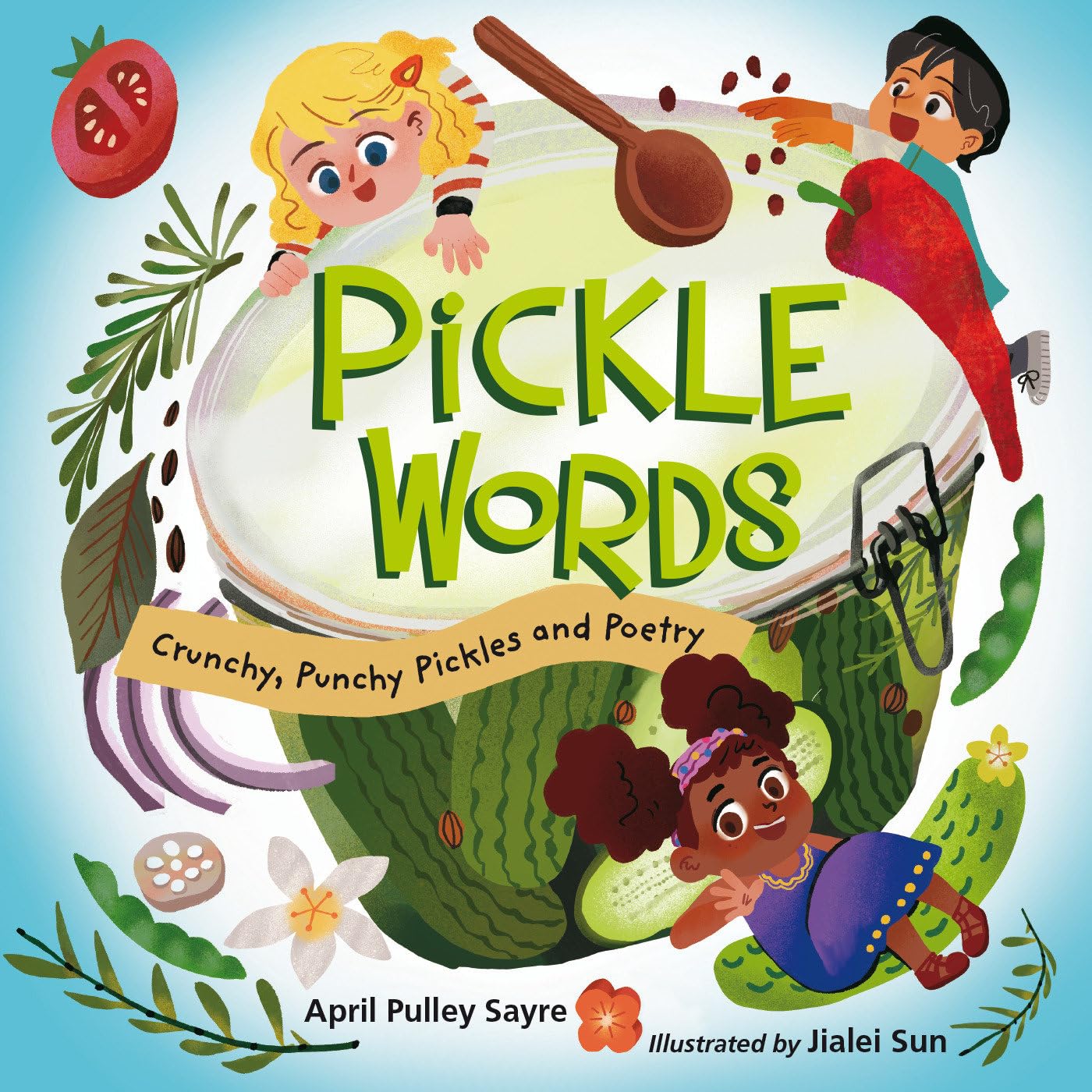 Pickle Words by April Pulley Sayre
This sweet and spicy celebration of all things pickled is the perfect poetry picture book for foodies of all ages! Open this book to savor a riotous rainbow of pickles. Not just green cucumbers, but yellow peppers, pink cabbages, and purple plums! Pickles come in all shapes and sizes—and so do the words that describe them. Punchy poetry and zesty art tell the story of a diverse community drawn together by their love of pickles. From kosher dills to sweet chutney to tangy kimchi, Pickle Words describes them all in this global tour of pickled foods. Back matter includes the science of pickling, an easy recipe for refrigerator pickles, and a visual glossary of pickles from around the world.